
Comprehensive overview as the basis for objective decisions

IT Security Maturity Assessment: Identify Risks and Prioritize Measures

Many companies already invest in cybersecurity, yet the effectiveness of measures, key risks, and where investments deliver the greatest benefit often remain unclear. An IT security maturity assessment uses a structured review to measure the current state of information security in your company.

Our cybersecurity maturity assessment provides dashboards, heatmaps, and maturity profiles that reveal strengths and areas requiring action. This gives you a sound basis for allocating budgets and specialist resources to the most significant cyber risks and the most effective measures.

Schedule a free initial consultation now


Cybersecurity in the Race with AI

Artificial intelligence accelerates cyberattacks and changes attack patterns almost daily. Regulatory requirements are tightening, and qualified professionals are in short supply. The challenges are multifaceted—a cybersecurity maturity assessment provides clarity and shows where companies need to act most urgently:

Meet Regulatory Requirements
Identify the necessary areas for action in the context of NIS2, the Cyber Resilience Act, and critical infrastructure (KRITIS) and translate them into specific, prioritized measures.

Counter AI-Assisted Attacks
Take into account new risks arising from the use of AI, as well as the growing prevalence of AI-assisted attack methods. Learn where action is needed most and receive a prioritized cybersecurity roadmap.

Manage Risks in the Supply Chain
Attacks on suppliers or business partners can also affect your systems. Implement appropriate controls to minimize security risks arising from your supply chain.

Compensate for Talent Shortages
Shortages of IT security specialists can become a business risk. Reduce the burden on your teams and allocate limited resources where they will have the greatest impact.

Your Benefits from an IT Security Maturity Assessment
  • Visibility into the actual cybersecurity maturity level
  • Business-critical risks become visible
  • A realistic roadmap and clear priorities for the next steps
  • A transparent basis for management decisions
  • Enables more efficient use of limited budgets and skilled personnel.
  • Repeated assessments let you measure whether measures are effective and IT security is improving.
  • Clear documentation and, as a result, improved ability to demonstrate your security status to customers, partners, and regulators

An IT security maturity assessment does not prevent a cyberattack. It provides a stronger foundation for identifying risks early and implementing effective measures in the right order.
 

How Does the IT Security Maturity Assessment Work?

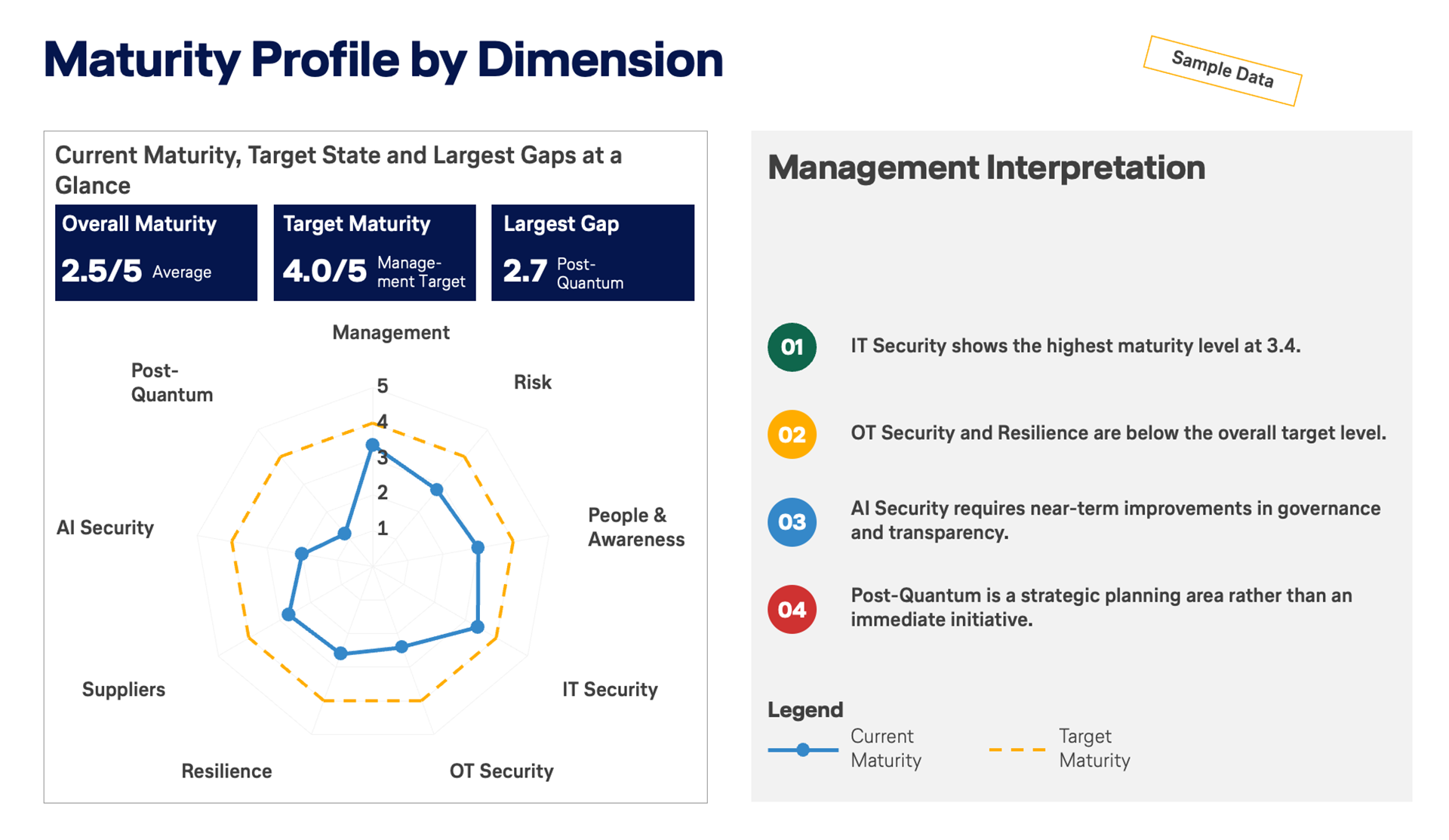
Maturity profile of a cybersecurity assessment with a radar chart for nine security dimensions (Management, Risk, People & Awareness, IT Security, OT Security, Resilience, Suppliers, AI Security, and Post-Quantum). The chart shows current maturity and target maturity, as well as the overall score, target score, and largest gap.
In the maturity assessment, IT security is examined from multiple perspectives. The different domains are rated on a maturity scale from 1 to 5.

1. Structured Self-Assessment

Before the workshop, you assess your cybersecurity maturity level using a questionnaire, document existing measures, and identify outstanding areas for action. This way, we can tailor our preparation to the relevant topics.

2. Workshop and Validation

Together with management and business units, we review the self-assessment in a one-day workshop and validate it against selected real-world examples. This is how we verify the actual implementation of security measures and determine the areas in which the target security level has not yet been achieved. We also assess their relevance to critical business processes.

3. Analysis and Roadmap

We then consolidate the findings into a complete picture. We prioritize the identified action items by business relevance, urgency, and implementation effort. We account for dependencies among the measures and establish a logical order for implementation.

The IT security maturity assessment provides a comprehensive baseline. It does not replace certification, legal review, or formal conformity assessment.

As a result of the IT security maturity assessment, you will receive:

  • Target-actual comparison and gap analysis
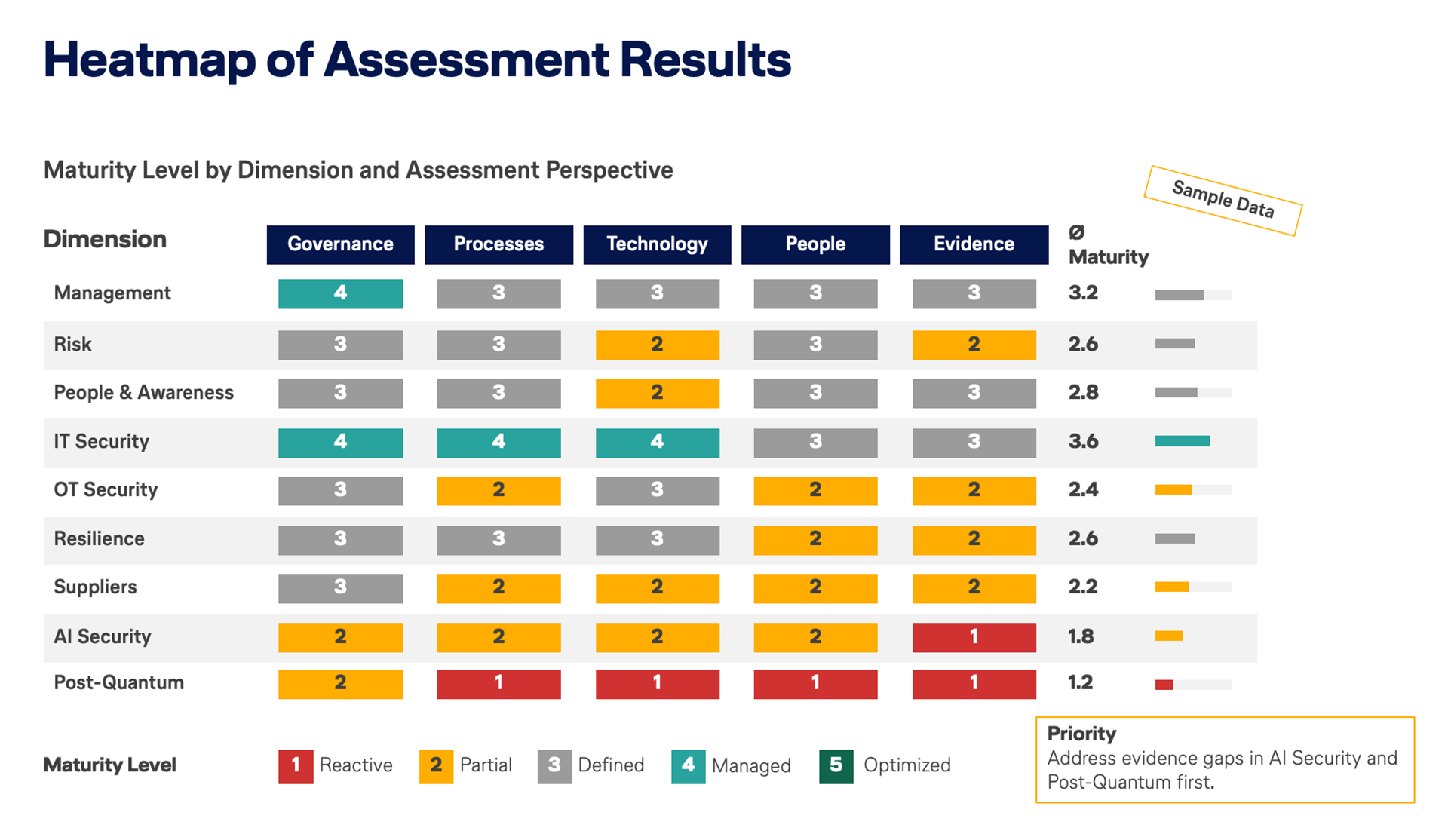
  • Dashboards, heatmaps, and maturity profiles
  • Prioritized recommendations for action and a realistic sequence of measures
  • Target values for measuring future progress

Lufthansa Industry Solutions: Our IT Security Expertise

Lufthansa Industry Solutions combines strategic security consulting with methodological and technical implementation. With our many years of experience with clients across industries, we take a holistic approach to cybersecurity from strategy through operations.

We offer:

  • More than 100 IT security specialists
  • 100 percent vendor-neutral consulting
  • Experience in highly regulated industries with the most stringent security requirements
  • Comprehensive view across technology, organization, and processes
  • Taking your specific needs and security requirements into account
  • An approach based on recognized standards and frameworks, as well as optional support for implementing prioritized measures, such as penetration testing or NIS2 consulting


Our label and certifications

A maturity assessment for IT security determines how well a company is prepared for cyberattacks and how effectively it manages its IT security across technology, processes, and the organization. It shows the current security maturity level, highlights strengths and gaps, and derives prioritized next steps.

The assessment includes, among other things, governance, risk management, IT and OT security, email security, security awareness, business continuity, suppliers, artificial intelligence, and preparation for post-quantum cryptography. Depending on your company, additional modules can be added. These include, for example, KRITIS-specific issues, regulatory requirements, sector-specific risks, or preparation for the Cyber Resilience Act. This results in an assessment that fits your industry, company size, and actual risk profile.

Our IT security maturity assessment is aligned with recognized standards, frameworks, and regulatory requirements, including the ISO/IEC 2700x series, the NIST Cybersecurity Framework, and the IEC 62443 series, as well as relevant requirements relating to critical infrastructure (KRITIS), NIS2, and the Cyber Resilience Act.

The IT security maturity assessment provides an enterprise-wide view of cybersecurity and business risks. An audit assesses compliance with the requirements of a standard, a gap analysis compares the current state with the target state, and a penetration test probes applications and systems for technical vulnerabilities through controlled attacks.

A risk analysis assesses threats, vulnerabilities, likelihoods, and potential impacts on the company. In the cybersecurity maturity assessment, these insights are used to prioritize measures based on their contribution to risk reduction.

It is particularly suitable for organizations with many concurrent security measures, limited resources, regulatory pressure, or an incomplete security roadmap. It also provides guidance following an incident, before major projects or organizational changes, and during strategy development.

Are You Interested in an Assessment of Your IT Security Maturity?

Contact us now – we will be happy to help!

captcha