
Many companies feel confident in their cybersecurity – until a security incident challenges that perception: The study "IT- & Cloud-Security 2027" by COMPUTERWOCHE Research Services in collaboration with Lufthansa Industry Solutions shows that there is often a gap between self-assessment and reality. In the study, you will also learn how AI agents are secured and why security is not just a technology problem.
Cyber resilience: perception versus reality
IT- & Cloud-Security 2027 Study: Technology Alone Isn’t Enough to Keep Companies Secure
Major Incidents Despite Seemingly Strong Cyber Protection
81% of the companies surveyed rate the quality of their cyber protection at six out of ten or higher. 24% even consider it very good or excellent. This suggests a high level of confidence in their own security posture.
The operational reality is far more sobering: 47% report at least one serious IT security incident over the past two years. There is a significant gap between perceived and actual IT security maturity levels.
AI Agent Adoption Is Outpacing Security Controls
59% of companies already use AI agents or have concrete plans to deploy them. At the same time, 54% cite potential data leaks as their primary concern, while 36% fear loss of control due to autonomous agents.
Security controls are not keeping pace: Only 23% of surveyed IT decision-makers have full visibility into the AI tools in use. 34% have clear policies for AI agents, and only 29% can trace their actions at any time. This means AI security is a matter of governance—not just technology.

- How companies secure AI agents
- Who is responsible for IT security in companies and who is involved in decision-making processes
- How IT decision-makers assess the risk of industrial espionage, ransomware, or supply chain attacks
- How well companies monitor their cloud security
- Which security areas companies plan to invest in – and what role training plays
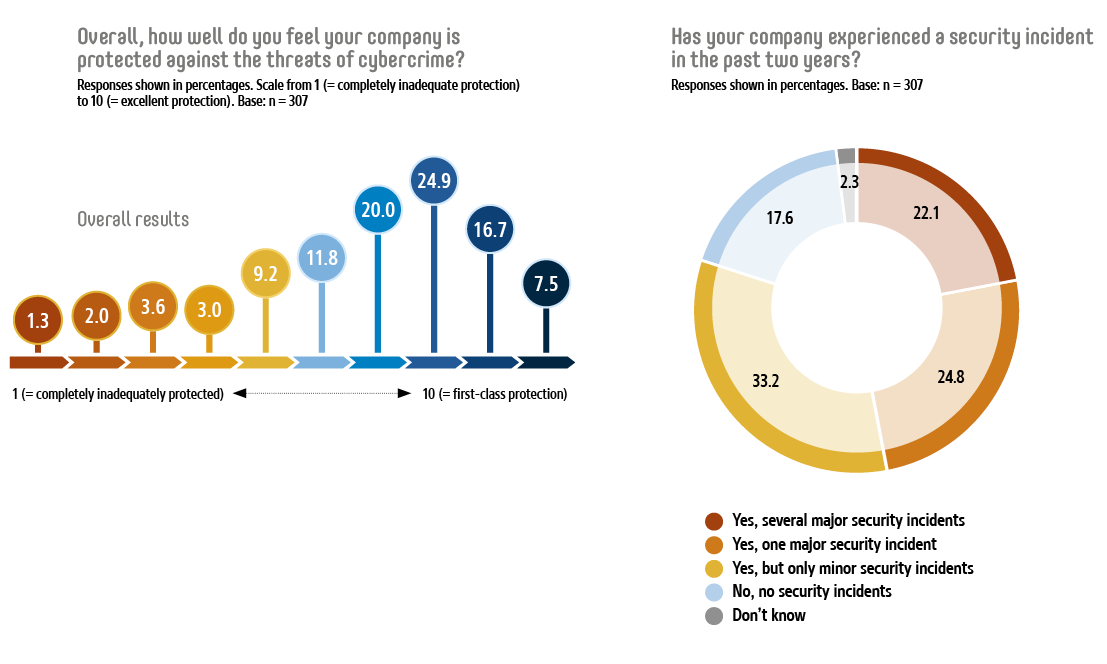
- Self-assessment and incident records do not align
81% rate their cyber protection at six out of ten or higher. At the same time, 47% experienced at least one serious IT security incident in the past two years. - Cloud adoption is outpacing oversight
70% use cloud services; another 23% plan to adopt them. However, only 30% monitor cloud configurations, content, and SaaS services very closely and comprehensively. - AI changes security priorities
51% expect protection against AI-driven attacks to become significantly more important. However, only 37% offer mandatory AI-related security training.