Modern Shopfloor App Replaces Fragmented Legacy System: Reports at the Touch of a Button
Lufthansa Technik Digitalizes Repair and Maintenance Process for APUs with Centeract
When repairing and maintaining auxiliary power units, a large amount of information on the individual components needs to be collected. This includes, in particular, findings and photos as well as operating times and information on the condition of the components, which must then be compiled into aviation-compliant final reports. Lufthansa Technik has now digitalized this entire complex process: A modern app pools data from multiple systems, supports the entire shopfloor process, and saves reporting time by up to 90% through automation.
The Customer
Lufthansa Technik (LHT) is one of the world’s leading providers of technical services for aircraft. The company, which is headquartered in Hamburg, offers maintenance, repair, overhaul, and modification work for aircraft, engines, components, and landing gear as well as digital fleet services. In 2025, Lufthansa Technik generated revenue of over eight billion euros and had around 23,000 employees.
LHIND Services at a Glance:
Development of central APU app based on Centeract
Replacement of an error-prone legacy system
Interface integration with several LHT systems
Change management and user training
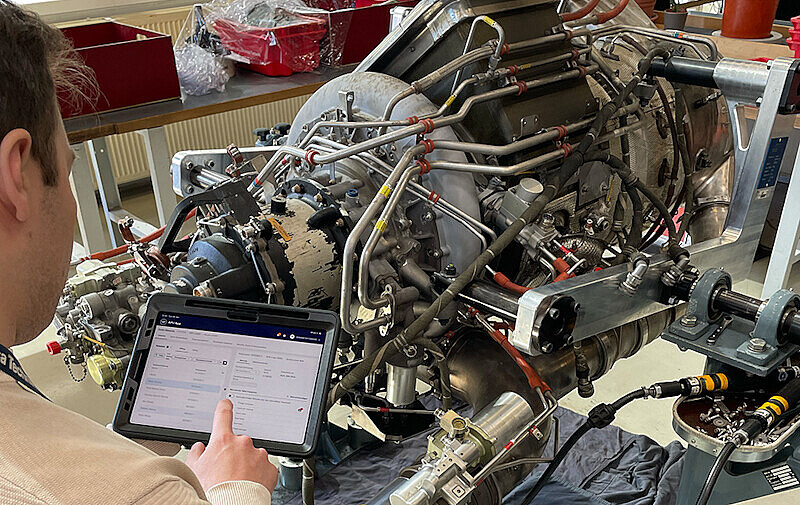
In the APU app, employees capture findings and process data directly at the component on the shop floor. The app consolidates information from multiple sources and makes it available for further processing.
The Challenge
When an auxiliary power unit (or APU for short) arrives at LHT for maintenance or repair, it goes through a complex process: It is taken to the so-called shopfloor – i.e. the actual workshop. There, the APU is dismantled, checked, cleaned, maintained, repaired, or replaced before being sent back to the customer. In the process, a large amount of information needs to be collected – for example technical process data, but also photos of worn or faulty components.
Until now, this information was recorded in an old MS Access solution. The application had long loading times and often crashed. Preparing the reports required for aviation safety was particularly time-consuming: The 90- to 100-page reports with photos and findings were compiled manually in the back office.
The Solution
Based on Centeract, LHIND developed a new shopfloor application that digitally supports the APU process and consolidates relevant information in a central user interface. Users can see all available engines and individual components, select findings in a structured manner, take and assign photos directly, and immediately record process information.
The solution links existing data from connected systems with information generated during work on the shopfloor. Data can be captured on a desktop or directly at the component using a smartphone or tablet. This digitally links photos, findings, and technical data during the process and makes them available for further processing.
A dedicated service generates the required reports from this information largely automatically. Instead of manually compiling extensive photo documentation and findings, users select the required report in the app; 90 to 95% of the content is automatically incorporated into the documentation and then only needs to be checked.
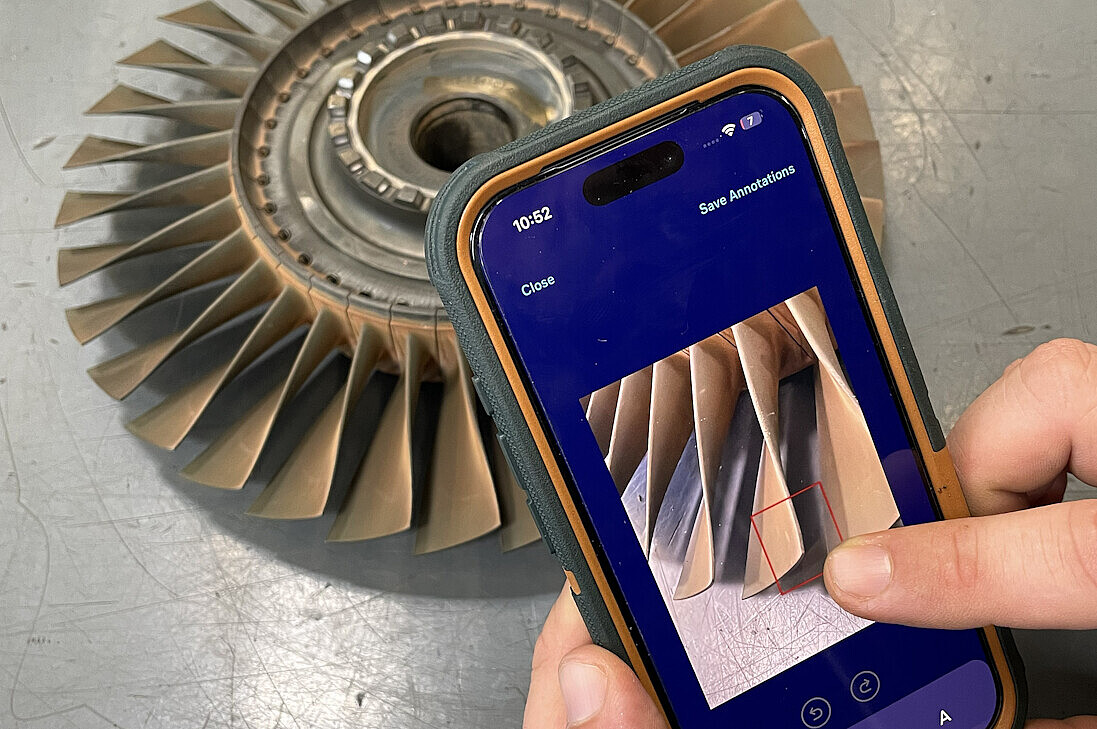
Findings can be photographed and annotated directly on the image.
Customer Benefits
The APU app digitalizes the entire APU value stream – from acceptance to final documentation. Instead of having to search for information in different systems or manually transfer it, users can work within a single interface that maps all relevant process steps. Photos, findings, and process data can be recorded, automatically assigned, and linked to existing data directly at the component. Replacing the old MS Access tool reduced the risk posed by a legacy application failing and, at the same time, increased productivity significantly: Checking the automatically generated reports now takes only around two hours instead of three to four days.
At a Glance: How Lufthansa Technik Benefited from the LHIND Solution:
Support for the entire end-to-end process with one app
Automation of report creation with approx. 90% time savings
Reduction of technical risks by replacing an outdated MS Access tool
More stable and scalable processes along the entire value stream
Mobile data capture directly at the component using a smartphone or tablet
Central user interface for all process data
Lufthansa Industry Solutions is very familiar with the requirements and procedures in the MRO environment. This understanding of the process was incorporated into Centeract, making the platform and its existing functionality an ideal basis for developing the APU app. This substantially reduced both development time and the associated risk.
Daniel Schoepflin Product Owner Digital Transformation Engine Services, Lufthansa Technik