
The right product may be only a few clicks away, yet it often remains overlooked. Large product ranges, insufficient product information, and long lists of search results make online purchase decisions difficult. AI-based shopping assistants provide guidance: They understand projects and requirements, offer advice through dialogue, and guide customers toward a more targeted selection. Our whitepaper explores how digital shopping advice benefits customers and retailers, how it changes customer journeys, and what retailers need to make it work.
AI-Based Shopping Advice in Retail
Whitepaper: Shopping Assistants - From Searching to Understanding and Finding
The Gap Between Search and Purchase in Online Stores
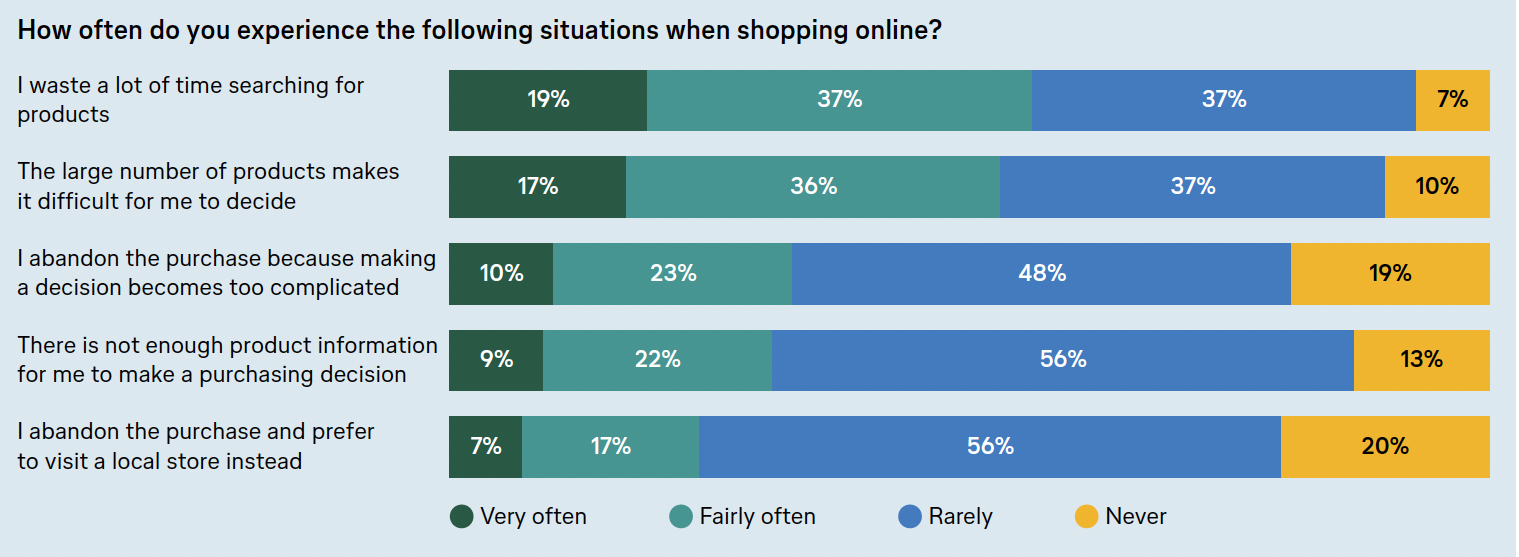
A survey of 1,044 people in Germany, commissioned by Lufthansa Industry Solutions (LHIND), shows that 76 percent use online stores to research products at least once a week, but only 54 percent shop there that often. The online store therefore frequently serves as a source of guidance and a decision-making channel before a shopping cart is even created.
Fifty-six percent of respondents said they spend too much time searching for products, while 53 percent view the large selection as a barrier to decision-making. One-third even abandon purchases because the decision becomes too complicated. This gives retailers an opportunity to reconnect search and advice.
From Search Field to Digital Shopping Advisor
A shopping assistant does more than just match keywords. Customers describe their goal in natural language – for example a project, an event, or special requirements – and receive suitable recommendations. The assistant can ask follow-up questions, explain product details clearly, create shopping lists, and simplify checkout.
Creating a reliable shopping experience requires more than a powerful language model. Complete, machine-readable product data, a robust system architecture, and clear rules for data protection, transparency, and security are essential.

- How customers and retailers benefit from digital shopping advice
- How digital and brick-and-mortar touchpoints come together to create a seamless customer journey
- How to Build Your Shopping Assistant in 10 Steps
- The Role of Data Quality, Architecture, Data Protection, and Security
- How OTTO, Germany’s largest online retailer, uses a shopping assistant
- Guidance Shapes Purchase Decisions
More than half of respondents spend too much time searching for products, and one-third abandon purchases when the decision becomes too complicated. Digital shopping assistants can address this barrier directly in the shopping process. - Dialogue Replaces Rigid Search Results
Shopping assistants understand projects, ask follow-up questions, and take context into account. This helps customers find products that better match their needs. - Data Quality Builds Reliability
Accurate product data, a clean data pipeline, and transparent data protection and security processes provide the foundation for reliable recommendations.