
Today's customers expect more from digital commerce than just a functional online shop and a wide range of products, as shown by a recent survey conducted by Lufthansa Industry Solutions (LHIND). Comprehensible advice and personalized product recommendations are in demand. Read our whitepaper to find out how you can use chatbots and AI-powered recommendation systems to offer your customers an online shopping experience that leaves nothing to be desired.
How retailers create better customer experiences
Whitepaper: Digital Retail – Engaging Customers with AI Recommendations
Survey: AI-Assisted Guidance and Recommendations Instead of Advertising
Roughly 89% of online customers are satisfied with their shopping experience – according to a recent survey conducted on behalf of LHIND. However, one issue is prompting debate: advertising. Some 44% of survey respondents said they consider current advertising levels excessive; 39% even feel outright “stalked”.
Instead, many customers are looking for genuine advice, which has so far been in short supply online. Chatbots are still rarely used for this purpose, although 60% of users are satisfied with them. Recommendation features are significantly more popular and are frequently used by 38% of users.
Specialized AI Solutions for Online Retail
Specialized AI solutions to meet customers’ increased requirements are already available. For example, the SHAPE (Semantic Hybrid Algorithm for Personalized Engagement) recommendation system from LHIND combines a recommendation engine with a digital sales assistant in the form of a language-model chatbot. This means that, rather than simply receiving a product list with recommendations, the customer benefits from personalized guidance based on their personal preferences and purchase history. A clean data structure is critical for this and other systems – and, without it, successful AI applications are impossible.

Check out our whitepaper to learn which issues matter most to the retail customers of tomorrow, what role chatbot-based guidance plays in online retail, and how AI-powered recommendation systems turn digital touchpoints into genuine customer experiences.
- The products with particularly high need for online advice
- The current state of customer trust in AI solutions
- The benefits customers hope to see from AI deployment in online retail
- How the SHAPE recommendation system elevates personalized advice to a new level
- The solutions LHIND offers today for digital commerce
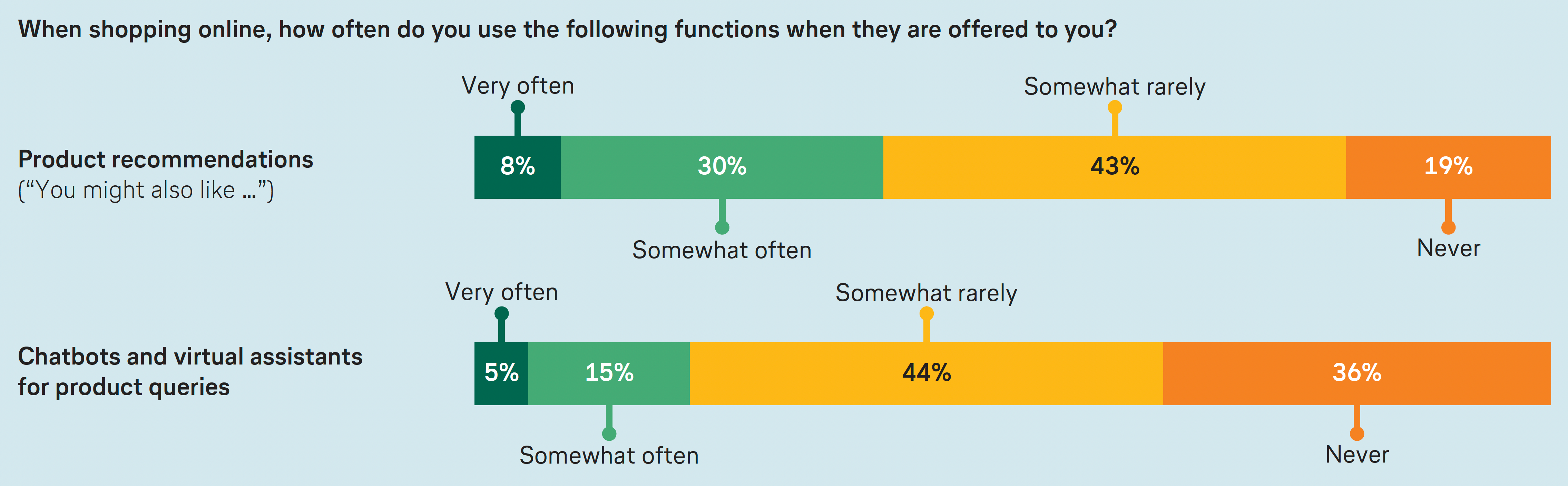
- Demand for online advice is rising
Instead of traditional advertising, customers are increasingly seeking genuine advice when shopping online. Although this task is primarily assigned to chatbots, they are still rarely used at present. - AI acceptance depends on age
Almost half of respondents (47%) in the 60+ age group remain skeptical of AI solutions; this figure drops to just 17% among respondents aged 29 and under. This clearly shows the direction in which online retailers must evolve to reach tomorrow’s high-value customers. - Data quality as a success factor
From customer data and product master data to clear product descriptions and interaction data, AI applications cannot succeed without a clean data structure.
Check out our whitepaper to learn which issues matter most to the retail customers of tomorrow, what role chatbot-based guidance plays in online retail, and how AI-powered recommendation systems turn digital touchpoints into genuine customer experiences.